
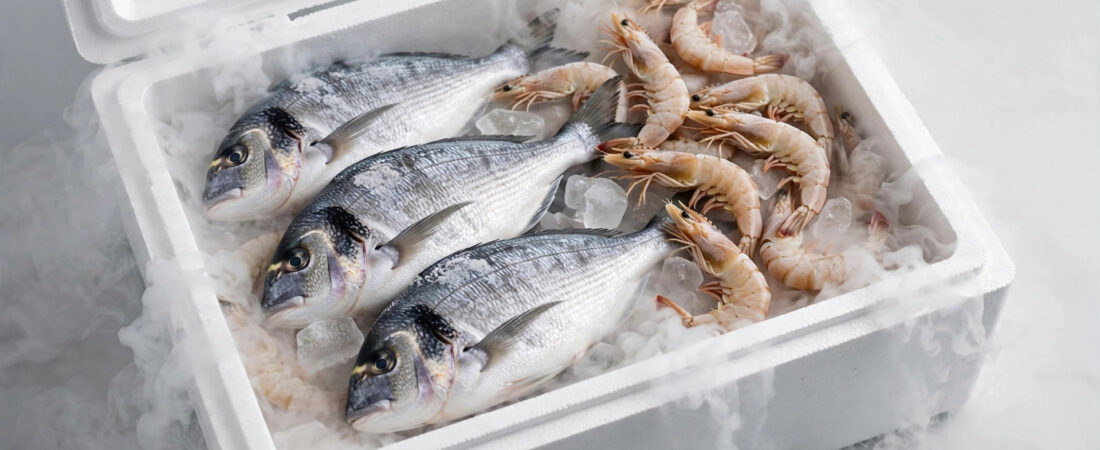
A fishing boat out of Karachi’s Fish Harbour can stay at sea for 12 hours or more, and every hour the catch spends unchilled is quality lost. Prawns turn soft, fish lose their firmness, and by the time the boat returns to the harbour the price at auction has dropped. The difference between a top-price catch and a mediocre one is often just how the fish were chilled in the first hours after being pulled from the water.
This guide explains how dry ice preserves the catch on fishing boats, why it beats regular ice at sea, and how Karachi’s fishermen and boat owners can use it practically.
1. Why the First Hours After the Catch Matter Most
Fish start deteriorating the moment they leave the water. Bacteria multiply fast in warm conditions, and in the Arabian Sea the surface temperature can be above 28°C for much of the year. A fish that is not chilled within the first hour or two will never recover its quality, however well it is packed later.
The rule on a good boat is simple: chill the catch as soon as it comes aboard. Fish go straight into an insulated hold or thermocol box with coolant — not into a pile on deck in the sun. Every minute on a hot deck costs money at the harbour auction.
2. Why Regular Ice Fails at Sea
Regular ice has two problems on a boat. First, it melts, and meltwater collects in the hold, softening the fish and washing away flavour. Second, it takes up a lot of space for the cooling it delivers.
Dry ice solves both problems. At around -78.5°C it is far colder than regular ice, it never melts into water — it turns directly into gas — and it delivers far more cooling per kilogram. A boat carrying 20 kg of dry ice gets more effective chilling than 100 kg of regular ice, with no meltwater in the hold at all.
3. How to Pack the Catch With Dry Ice
The standard method is layering. Line the bottom of an insulated hold or a large thermocol box with dry ice, add a layer of fish, then another layer of dry ice, and so on. Keep the dry ice above and around the fish rather than underneath only, since cold sinks — this way the whole load cools evenly.
Never let dry ice touch the fish directly for long periods, or it will freeze-burn the surface. A sheet of plastic, newspaper, or cloth between the dry ice and the catch is enough. Leave the hold lid slightly loose — dry ice releases carbon dioxide gas as it sublimates, and a fully sealed hold builds pressure. Our dry ice safety rules cover the full handling checklist for crew.
4. How Much Dry Ice Does a Boat Need?
A practical starting point is 1 kg of dry ice per 10 kg of expected catch for a day trip of 8 to 12 hours, packed in insulated boxes or a lined hold. A small boat bringing in 200 kg of fish needs roughly 20 kg of dry ice; a larger boat with a 500 kg catch needs 40 to 50 kg. Boats going out for two days should double the quantity and use 16 mm pellets, which sublimate more slowly than fine pellets and last longer in the hold.
The exact amount depends on the season, the hold insulation, and how often the lid is opened. Well-insulated holds with tight lids use far less. Our dry ice quantity guide helps boat owners size orders, and bulk buying for businesses explains how regular buyers save on weekly orders.
5. Keeping the Catch Cold From Boat to Market
The cold chain does not end when the boat docks. Fish unloaded at Fish Harbour still need to stay cold through auction, transport to Saddar or Empress Market, and delivery to restaurants and exporters. The most common failure is a gap: the catch was perfectly chilled at sea, then sat in the sun on the jetty for two hours.
6. Ventilation and Crew Safety
Dry ice releases carbon dioxide, which is heavier than air and collects in low, enclosed spaces like a boat’s hold. Crew should never climb into a hold that has been sealed with dry ice inside without ventilating it first — open the hatch and let fresh air in for a few minutes. Work with gloves when handling dry ice, and store it in a ventilated area of the boat, never in a sealed cabin. These are simple rules, but on a small boat they are the difference between a safe trip and a dangerous one.
The Harbour-Day Checklist
Order dry ice the day before sailing so it is fresh and at full strength. Pack the hold in layers, keep dry ice off direct contact with the fish, ventilate before entering the hold, and keep a reserve for unloading at the harbour. That is the whole system — and it is what keeps a Karachi catch at auction-grade quality from sea to market.
Order Providers delivers dry ice across Karachi the same day, including to Fish Harbour and Ibrahim Hyderi, in quantities from 2 kg to bulk orders of 50 kg and more. Message us on WhatsApp for the right quantity for your boat and trip length, or browse dry ice and packaging in our shop.
Frequently Asked Questions
Is dry ice safe to use on a fishing boat?
Yes, with basic precautions. Handle it with gloves, never seal it in an airtight hold, and ventilate the hold before climbing in. The carbon dioxide it releases is the same gas used to carbonate soft drinks.
How long does dry ice last in a boat’s fish hold?
In a well-insulated hold, 16 mm dry ice pellets last 18 to 24 hours, depending on how often the lid is opened and the outside temperature. That covers a full day trip with a comfortable margin.
Will dry ice freeze the fish solid?
It can if it touches the fish directly for a long time, which is why you always put a barrier — plastic sheet, newspaper, or cloth — between the dry ice and the catch. Layered properly, it chills without freeze-burning.
Can I get dry ice delivered to Fish Harbour early in the morning?
Yes. We deliver same-day across Karachi, including Fish Harbour and Ibrahim Hyderi. Order the day before or early in the morning and the dry ice arrives before the boat sails.