
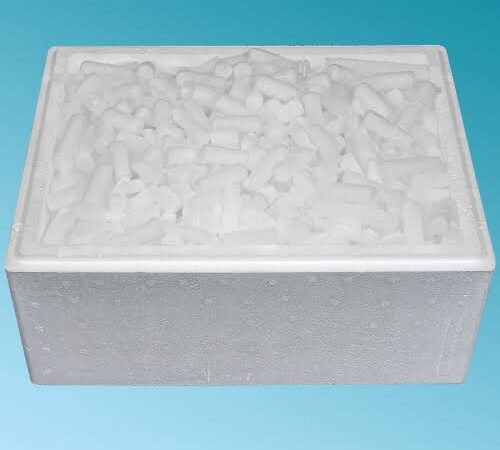
Some medicines and vaccines stop working if they get warm — even for a short time. Insulin, vaccines, certain cancer drugs, blood samples, and lab reagents all travel through a “cold chain”: a chain of refrigerated packing and handling that keeps them at the right temperature from the supplier’s door to the patient’s. In Karachi, where summer temperatures pass 40°C and traffic can turn a 20-minute trip into a two-hour one, the cold chain is only as strong as its weakest packing box.
This guide explains the basics of transporting vaccines and medicines with dry ice: the temperatures that matter, the packing method pharmacies and labs actually use, and the mistakes that ruin a shipment.
The Temperatures That Matter
Most medicines have a printed storage range, and the two you will see most often are 2–8°C (ordinary refrigerator range, for most vaccines, insulin, and biologics) and -20°C or below (deep-frozen, for some vaccines, plasma, and certain lab reagents). A few ultra-sensitive products need -70°C, which is where dry ice earns its place.
The key point: dry ice sits at roughly -78.5°C. That is far colder than any medicine needs, so it is never placed against the product directly. It works as the engine of cold inside an insulated box, with the medicine packed in its own layer of insulation (bubble wrap, thermocol dividers, or the product’s own secondary packaging). Our lab and medical samples guide covers the temperature bands in more detail.
Why Dry Ice Instead of a Fridge Box or Gel Packs
Gel packs and ice bricks melt into water. That is fine for a short trip, but on a long Karachi route — say, Saddar to Bahria Town at noon in June — melted ice means the box warms up exactly when the journey gets longest. Dry ice sublimates: it turns straight from solid to cold carbon dioxide gas, leaving no water, no soggy cartons, no labels ruined by moisture.
Dry ice also lasts longer per kilogram. A well-packed thermocol box with dry ice holds deep-frozen temperatures for 24 to 48 hours, versus a few hours for gel packs in the same box. For anything travelling between cities — Karachi to Hyderabad, Lahore, or a remote clinic upcountry — that margin is the difference between a valid dose and a wasted one. Our dry ice vs gel packs comparison breaks down the trade-offs.
How to Pack Medicines With Dry Ice
The packing method matters more than the quantity. Follow this order inside a thermocol box:
1. Line the box. Place a layer of crumpled paper or bubble wrap at the bottom. This cushions vials and keeps them off the coldest surface.
2. Add the medicine first. Vials, syringes, or reagent kits go in their own sealed poly bag (moisture protection), then wrapped in a layer of bubble wrap or newspaper. The wrap is not just padding — it is the insulation that keeps the product at 2–8°C while the dry ice holds -70°C nearby.
3. Place dry ice above and around, never touching the product. Cold sinks, so dry ice on top cools everything below it. Keep at least a few centimetres of insulation between dry ice and any medicine. Direct contact can freeze a 2–8°C product solid and destroy it just as surely as heat would.
4. Fill dead space. Air gaps warm up fast. Fill them with crumpled paper or extra bubble wrap.
5. Close the lid without sealing it airtight. Dry ice releases CO₂ gas as it sublimates; the box needs a small escape path. Tape the lid shut but never shrink-wrap the box. Our dry ice safety rules explain why this matters.
6. Label it. “Medical — keep cold”, “This side up”, and the recipient’s phone number. In Karachi’s courier chaos, a clear label is cheap insurance.
How Much Dry Ice for a Medicine Shipment?
A rough rule for a standard thermocol box (the 5kg size): 2 to 3 kg of dry ice pellets holds deep-frozen temperatures for 24 hours; 4 to 5 kg stretches that toward 48 hours. For 2–8°C products, you actually need less — 1 to 2 kg is often enough, since you are not trying to reach -70°C, just to keep the box cold against the heat outside. Our quantity guide has a calculator-style breakdown for sizing any shipment.
For clinics ordering regularly, the practical move is a standing weekly schedule: dry ice delivered the morning of dispatch day, so it is fresh and full-strength when the shipment leaves. Order Providers delivers dry ice across Karachi the same day — message us on WhatsApp for a standing clinic or pharmacy arrangement, or browse dry ice and thermocol boxes in our shop.
Mistakes That Ruin Medicine Shipments
Sealing the box airtight. CO₂ build-up can pop a sealed box or, worse, create pressure. Always leave a vent path.
Putting dry ice against vials. Freezing destroys many vaccines and biologics. Insulation between dry ice and product is non-negotiable.
Underestimating Karachi traffic. Plan for the worst-case journey, not the best. If the trip could take three hours, pack for six.
Using a thin box. Cheap, thin-walled thermocol leaks cold fast. The 5kg box size with decent wall thickness is the workhorse for medical shipments; our thermocol box guide covers sizes and what to look for.
Frequently Asked Questions
Can dry ice keep vaccines at 2–8°C?
Yes, with proper insulation between the dry ice and the product. The dry ice holds the box cold; the insulation layer keeps the medicine in its 2–8°C band. Never let dry ice touch vials directly.
How long does a dry ice box stay cold for medicine transport?
A properly packed 5kg thermocol box with 2–3 kg of dry ice holds deep-frozen temperatures for about 24 hours, and 2–8°C products stay in range comfortably within that window. For longer trips, use 4–5 kg.
Is it safe to carry dry ice in a car?
Yes, with ventilation — keep a window slightly open, since sublimating dry ice releases CO₂. Never transport it in a sealed car boot on a long trip. See our full dry ice safety rules.
What is the cold chain, in simple terms?
It is the unbroken series of refrigerated packing, transport, and storage steps that keeps a temperature-sensitive product cold from the manufacturer to the patient. One warm gap — one bad box, one long traffic jam — can break it.