
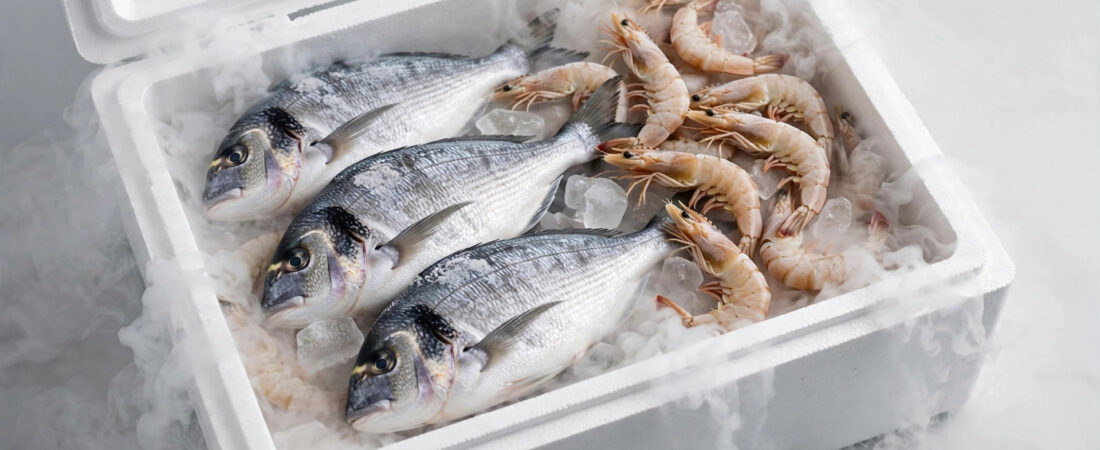
Shipping frozen food in Pakistan sounds simple until the parcel reaches the customer half-thawed. Between warehouse loading, city traffic, and summer heat that crosses 40°C, every hour of the journey eats into your frozen margin. The good news is that a frozen parcel does not need a refrigerated truck to survive the trip — it needs the right packing: dry ice, insulated EPS thermocol boxes, and a packing method that keeps the cold where it belongs.
This guide explains how to ship frozen food within Karachi and to other Pakistani cities — prawns, ice cream, cheese, frozen parathas, meat and more — so it arrives rock-solid, not soggy.
The Three Pillars of a Frozen Shipment
Every successful frozen delivery rests on three things working together:
- Dry ice — at −78.5°C, it is the only coolant strong enough for multi-hour frozen shipments. Ordinary ice melts into water; gel packs go soft; dry ice sublimates into harmless CO₂ gas, so your products never sit in a puddle.
- Insulation — thick-walled EPS (thermocol) boxes are the standard for frozen food in Pakistan. They slow heat transfer so the dry ice lasts longer.
- Packing technique — how you layer products, fill empty space, and seal the box matters as much as what you put inside.
Skip any one of the three and the other two cannot compensate for it.
Step 1: Pre-Freeze Everything
The most common mistake is packing products that are only half-frozen. If your prawns or kebabs are at −5°C instead of −18°C when they go into the box, you are starting the journey with a handicap. Always:
- Deep-freeze products to at least −18°C before packing (24 hours in a chest freezer is safer than 6).
- Pre-chill the thermocol box with a small amount of dry ice while you prepare the order.
- Freeze the dry ice too — fresh dry ice straight from the supplier is at its coldest; never let it sit unpacked in a warm storeroom.
Step 2: Choose the Right Box
For shipments within Karachi, a 3kg or 5kg EPS thermocol box covers most orders. For intercity shipments (Lahore, Islamabad, Rawalpindi, Multan, Faisalabad), use a thicker-walled 5kg box or a larger EPS shipper — the journey is longer, and cargo holds of buses and trucks are not temperature-controlled.
Read our detailed guide on thermocol box sizes and how to choose between 3kg and 5kg before you buy packaging.
Step 3: Layer Like a Professional
Pack your box in this order, bottom to top:
- A bed of dry ice on the floor of the box (use 16mm pellets — they pack evenly and cover more surface).
- A sheet of newspaper or kraft paper — a thin barrier between the dry ice and the products so they are not in direct contact.
- The frozen products, packed tightly so they touch as little warm air as possible. Fill every gap with crumpled paper — empty air space is the enemy.
- Dry ice on top — cold air sinks, so a top layer protects the products below. This is the layer most people forget.
- Seal and tape — close the thermocol lid and tape the outer box shut. Do not make the box airtight; a small gap lets sublimating CO₂ escape. Never use shrink wrap as the only closure.
As a rule of thumb, plan roughly 2.5–5kg of dry ice per 24 hours of transit depending on box quality and outside temperature. Our dry ice quantity guide walks through the calculation in detail.
Within Karachi: Same-Day Rules
Karachi deliveries are short enough that a well-packed box almost never fails — provided you dispatch smartly:
- Ship before noon in summer. Afternoon traffic plus 40°C heat is the worst combination for frozen goods.
- Use a shaded, ventilated vehicle. Never leave packed boxes sitting in a parked car with the windows up — interior temperatures can hit 60°C within minutes.
- Label the box “FROZEN — KEEP COOL” so riders and handlers treat it with care.
- Share handling notes with the customer — a short WhatsApp message (“dry ice inside, use gloves, open within 4 hours”) prevents accidents and complaints.
Intercity: The 24-Hour Game
For shipments to Lahore, Islamabad or beyond, assume 18–24 hours in transit. Bus cargo and freight forwarders are reliable, but they will not refrigerate your parcel. This is where dry ice proves its value:
- Double the dry ice you would use for a Karachi trip.
- Use the thickest-walled EPS box you can get.
- Dispatch in the evening so the parcel travels through the cooler night hours.
- Confirm the receiver’s phone number with the cargo office — delays at the destination terminal are where frozen shipments usually fail.
What to Never Do
- Never ship with regular ice for frozen food — it melts into water and soaks your packaging and products.
- Never seal dry ice airtight — sublimating gas builds pressure and can rupture the container.
- Never handle dry ice with bare hands — −78.5°C causes instant burns. Gloves or tongs only.
- Never skip the gap-filling — a half-empty box is a half-failed shipment, however much dry ice you used.
Ready to pack your first frozen shipment? Browse our dry ice and thermocol packaging range or send your requirement on WhatsApp — quantity, destination, and deadline — and we will quote packing for your exact route.
Frequently Asked Questions
How much dry ice do I need to ship frozen food for 24 hours?
Roughly 2.5–5kg of dry ice per 24 hours in a quality insulated box, depending on ambient temperature and how full the box is. Intercity shipments in summer need the higher end of that range.
Can I ship frozen food to Lahore or Islamabad from Karachi?
Yes. Pack frozen products in a thick-walled EPS thermocol box with dry ice top and bottom, seal it well, and dispatch by bus cargo or freight in the evening. Most parcels arrive solidly frozen the next morning.
Is dry ice safe to ship with food?
Yes. Dry ice is frozen carbon dioxide — it does not melt into liquid, so food never touches it in water form. Keep a paper barrier between the dry ice and the products, and never handle it with bare hands.
What is the cheapest way to ship frozen items within Karachi?
A 3kg EPS thermocol box with 1–2kg of dry ice, dispatched same-day through a courier or your own rider. For today’s dry ice rate in Karachi, message us on WhatsApp.