
Starting a frozen food business in Pakistan sounds simple: make a good product, freeze it, and sell it. The part that decides whether customers come back, however, is rarely the recipe. It is the packaging. Packaging is what keeps a frozen paratha, a packet of prawns, or a tub of ice cream safe, intact, and appetising from your freezer to a customer’s home in Karachi heat, on a bumpy bike ride, and through a power cut.
This guide covers the packaging choices that protect a frozen food product in Pakistan: the box, the cooling, the inner wrap, and the small details that separate a professional brand from a leaking parcel.
Packaging Has Three Jobs, Not One
Good frozen food packaging must do three things at once. First, it must hold temperature, so the product stays at -18°C or colder until it reaches the customer. Second, it must protect the product physically, so packets do not crush, leak, or break open in transit. Third, it must present the product well, because a stained, soggy, or unlabelled parcel tells the customer nothing good about what is inside.
Many new sellers focus only on the third job, the look of the box, and discover the problem on the first hot delivery day. A beautiful box that lets the product thaw is worse than a plain box that keeps it frozen. Temperature comes first, protection second, and presentation third, and the best packaging does all three.
The good news is that none of this requires expensive imported equipment. The standard professional setup in Karachi, a thick EPS thermocol box plus dry ice, is affordable, widely available, and proven across thousands of deliveries.
The Outer Box: Why Thermocol Wins in Karachi
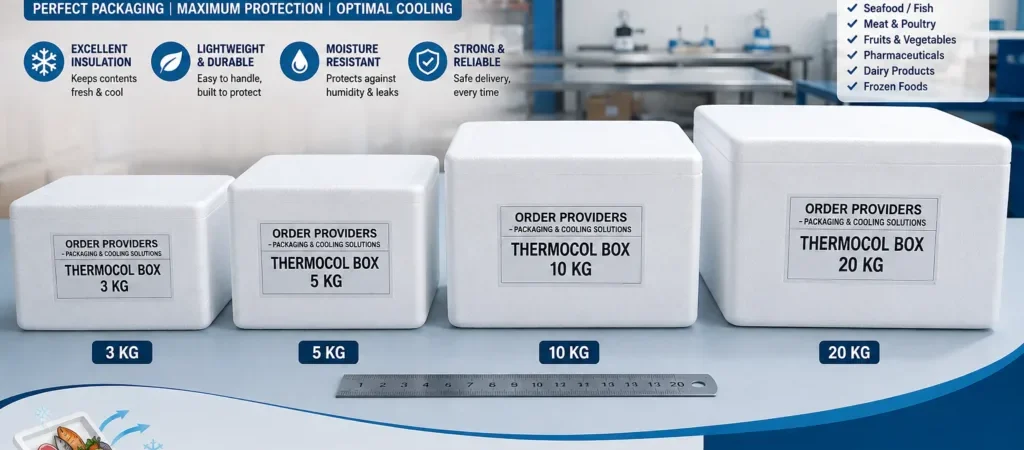
Thermocol, or EPS foam, insulates far better than cardboard alone, because millions of tiny air pockets in the foam slow heat transfer. A 3kg thermocol box suits small orders, a single product, or a short local delivery, while a 5kg box suits larger orders, mixed products, or longer routes across the city. Our thermocol box guide compares sizes, prices, and how to choose between them.
Choose the box for the largest order you realistically deliver, not the smallest. An overfilled box with a lid that will not close properly loses cold fast, and a box packed so tightly that packets press against the walls will thaw at the edges first. Leave room for the cooling, close the lid firmly, and tape it shut for the ride.
The Cooling: Dry Ice, Gel Packs, or Both?
Dry ice, at -78.5°C, is the strongest cooling available for frozen deliveries, and it is the only option that holds deep cold for 24 to 48 hours in a good box. It also turns to gas instead of melting, so it never soaks your product. For most frozen food businesses, it is the default choice.
Gel packs and regular ice have their place for short, chilled deliveries, but they melt, they add water to the box, and they run out of cold far sooner. Our comparison of dry ice vs gel packs vs regular ice shows where each one works and where each one fails.
Size the dry ice for the worst-case delivery, not the best case. If the route might take three hours in traffic, pack for four. Place dry ice at the bottom and on top of the load, because cold sinks, and never seal a dry ice box airtight. Our quantity guide shows the calculation, and our dry ice safety guide covers handling for your team.
The Inner Wrap: The Detail Most Sellers Skip
Inside the box, each product needs its own sealed, food-grade wrap or pouch. This stops freezer burn, stops flavours moving between products, and stops a leaking packet from ruining the whole order. Prawns, in particular, need careful sealing: our prawn and seafood packing guide explains the method that keeps them intact and odour-free.
Label every inner pouch with the product name, the quantity, and the date it was packed. Customers trust a labelled product, and you can trace a complaint back to a batch in seconds. Add a short handling note to the box itself: keep frozen, do not refreeze once thawed, and do not touch dry ice with bare hands. That one note prevents most of the confused messages sellers receive after delivery.
Packaging for the Real Karachi Delivery
Test your packaging the way your customer will receive it. Pack a box exactly as you would for an order, leave it in a warm room or on a bike for the length of your longest route, and then open it and check. Is the product still hard-frozen? Is the box dry inside? Did anything leak or crush?
That one test, repeated whenever you change a supplier, a box size, or a product, catches most packaging failures before a customer does. It also tells you your true dry ice quantity, which is worth more than any estimate on paper. Our frozen food shipping guide walks through the full packing routine, and our cold chain guide shows how packaging fits into the wider journey from freezer to doorstep.
Ready to package your product properly? Message Order Providers on WhatsApp with your product type, your order sizes, and your delivery areas, and we will quote the dry ice and thermocol boxes your business needs. You can also browse dry ice and packaging in our shop.
Frequently Asked Questions
What is the best packaging for frozen food in Pakistan?
For most businesses, a thick EPS thermocol box with dry ice, sealed food-grade inner pouches, and a labelled outer carton. That combination holds temperature, protects the product, and presents it professionally, without expensive equipment.
Should I use a 3kg or 5kg thermocol box?
Use a 3kg box for small, single-product orders and short local deliveries, and a 5kg box for larger, mixed, or longer-route orders. If the lid will not close comfortably, move up a size rather than squeezing the order in.
Does dry ice damage frozen food packaging?
No, when used correctly. Dry ice turns to gas instead of melting, so it never soaks packaging. Keep it from direct contact with thin plastic pouches where possible, never seal the box airtight, and handle it only with gloves.
How do I test my packaging before selling?
Pack a real order, leave it for the length of your longest delivery route in warm conditions, then open it and check that the product is still hard-frozen and the box is dry inside. Repeat the test whenever you change a box, supplier, or product.