
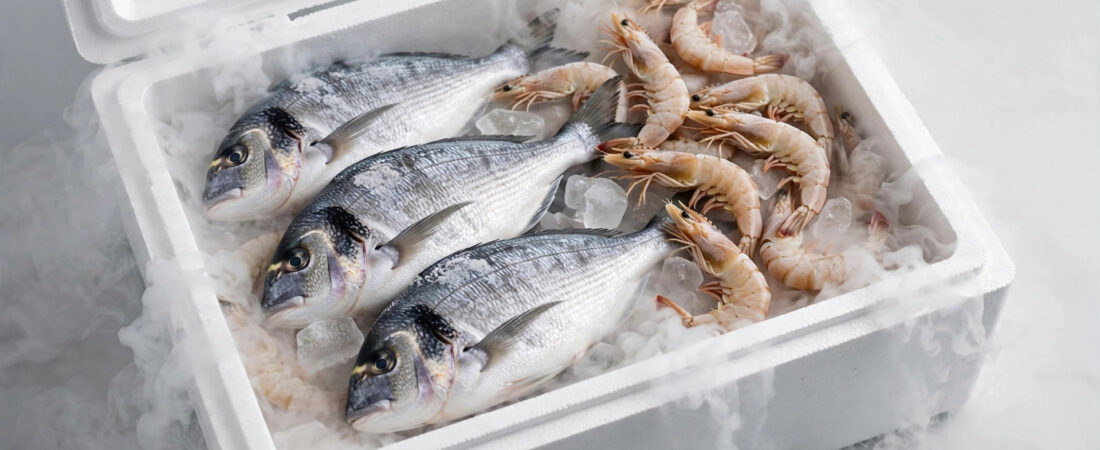
If you sell frozen food in Karachi, you are already part of a cold chain — whether you call it that or not. The cold chain is simply the unbroken series of cold steps that keeps a product frozen from the moment it leaves your freezer until it reaches your customer. Break it once, even for an hour in Karachi heat, and the product may look fine while its quality, safety, and shelf life are already gone.
This guide explains the cold chain in plain terms: what it is, where it usually breaks in Karachi, and how a small food business can run one properly without buying expensive equipment.
What Is a Cold Chain, Exactly?
A cold chain has four links: storage, packing, transport, and delivery. Your freezer is link one. The insulated box and dry ice you pack in is link two. The rider or van carrying it is link three. And the customer’s doorstep — where the box is opened, checked, and put away — is link four.
The chain is only as strong as its weakest link. A perfect freezer cannot rescue a box that sat open in the sun, and perfect packing cannot rescue a delivery route that took four hours across the city in July. Every link has to hold, every time.
For most frozen foods the safe line is −18°C or colder. Above that, bacteria do not necessarily make food dangerous immediately, but quality drops fast: texture changes, flavours dull, and ice crystals grow. For ice cream the line is even stricter, as our ice cream delivery guide explains.
Where Karachi’s Cold Chain Usually Breaks
Karachi adds three problems that colder cities do not face. First, the heat: summer air at 40°C attacks every box from the outside. Second, traffic: a 30-minute route can become two hours without warning. Third, load-shedding: a freezer that warms during a long power cut can silently break the chain before packing even starts.
Link 1: Storage That Actually Stays Cold
Your freezer should hold −18°C or colder, and you should be able to prove it. A simple thermometer inside the freezer, checked morning and evening, is enough for a small business. If the temperature climbs during load-shedding, keep dry ice on hand: a few kilos in the freezer during a power cut buys you hours of protection.
Link 2: Packing — Dry Ice and the Right Box
Packing is where most Karachi businesses win or lose the cold chain. The standard professional setup is a thick EPS thermocol box plus dry ice at −78.5°C. Dry ice is the only cooling medium that holds deep cold for 24–48 hours in a good box, and because it turns to gas instead of melting, it never soaks your product.
Choose the box for the load, not the price: a 3kg box suits small orders and a 5kg box suits larger or multi-stop deliveries. Our thermocol box guide compares sizes and shows how to pick. Always chill the box before loading, pack dry ice at the bottom and on top (cold sinks), and close the lid firmly — but never seal a dry ice box airtight, because the gas needs an escape path. Full handling rules are in our dry ice safety guide.
Size your dry ice for the worst-case route, not the best case. If the trip might take three hours, pack for four. Our quantity guide shows how to calculate it, and the full packing method is covered in our frozen food shipping guide.
Link 3: Transport — Planning the Route
A cold chain is a route plan as much as a packing plan. Batch deliveries by neighbourhood — DHA orders together, Gulshan orders together — instead of zig-zagging across the city. Tell customers a realistic time window, and brief riders on three rules: the box stays closed at every stop, it is opened only for the item being handed over, and it never waits in direct sun.
If a customer is not home, the rider should not wait with an open box. Agree a policy in advance — one call, two minutes, move on — and tell customers about it when they order. A single abandoned wait in July heat can undo perfect packing.
Link 4: The Last Few Minutes
The chain ends when the customer puts the product in their freezer, not when the rider arrives. A short note in every box closes the loop: “Packed with dry ice in an insulated box — please freeze immediately and do not touch the dry ice with bare hands.”
Starting Small: A One-Day Cold Chain Setup
You do not need a refrigerated van to start. You need a thermometer in your freezer, a stock of thermocol boxes, a reliable dry ice supplier, and a written packing routine that every staff member follows the same way. Add a route plan and a customer note, and you have a working cold chain.
Ready to set yours up? Message Order Providers on WhatsApp with your product type, daily volume, and delivery areas — we will quote the dry ice and thermocol boxes your cold chain needs, and advise on quantities for your routes. You can also browse dry ice and packaging in our shop.
Frequently Asked Questions
What temperature must a cold chain maintain?
For most frozen foods, −18°C or colder throughout storage, packing, transport, and delivery. Ice cream and some seafood need colder handling — check the product’s own storage guidance and pack accordingly.
Do I need a refrigerated van for a cold chain in Karachi?
Not to start. A well-packed thermocol box with enough dry ice holds frozen temperatures for 24–48 hours, which covers any same-city route. A refrigerated van becomes worthwhile only at high daily volumes.
How does load-shedding affect my cold chain?
A freezer warms slowly if kept closed, but a long outage can still break the chain. Keep dry ice on hand as backup cooling, keep the freezer door shut during outages, and check the thermometer before packing any stock after a power cut.
How do I know if my cold chain broke?
Look for softened texture, frost or ice crystals inside packaging, or a freezer thermometer reading above −18°C. If a delivery arrived warm or late, check your packing record and route time to find which link failed, then fix that link before the next delivery.