
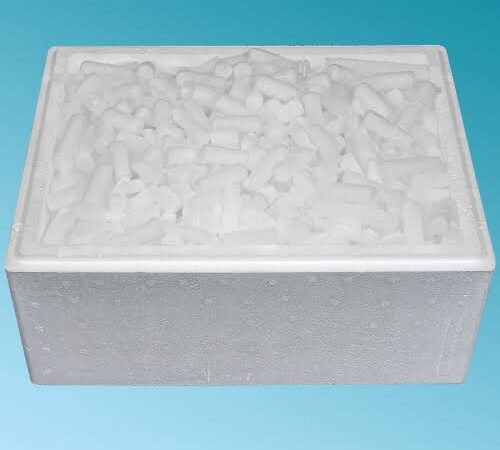
Dry ice comes in two main forms: small pellets and solid blocks. Both are frozen carbon dioxide at roughly -78.5°C, and both keep things cold — but they behave very differently in practice. Pick the wrong form and your delivery arrives half-sublimated, your food gets freeze-burned, or you pay more than you needed to.
This guide explains how pellets and blocks differ, where each one wins, and which form to choose for your delivery, event, or business in Karachi.
What Are Dry Ice Pellets?
Dry ice pellets are small, rice-sized pieces of solid carbon dioxide, usually around 16mm in diameter. They pour like gravel, fill gaps easily, and cool whatever they touch from all sides. Order Providers supplies 16mm pellets as standard — the same form used by most Karachi sellers for frozen food delivery.
Pellets are sold by weight: 2 kg (Rs 1,450), 5 kg (Rs 2,950), 10 kg (Rs 5,950), 15 kg (Rs 10,750), and 20 kg (Rs 11,450), with bulk orders of 40 kg or more at Rs 400 per kg. The minimum order is 2 kg. Browse all sizes in our shop.
What Are Dry Ice Blocks?
Dry ice blocks are large solid slabs, typically cut to size from a bigger slab. Because a block has far less surface area exposed to warm air than the same weight of pellets, it sublimates much more slowly. A block can last a full day or more in a good thermocol box, while pellets of the same weight may be gone in hours.
Blocks are harder to handle: they are heavy, they need to be cut or broken for most uses, and they cool unevenly — the surface touching the block freezes hard while the rest of the box stays warmer. For that reason, blocks suit long, slow cooling jobs rather than quick packing.
Pellets vs Blocks: The Key Differences
The first difference is cooling speed. Pellets cool fast because their huge combined surface area pulls heat out of everything around them within minutes. That makes them ideal for a delivery that leaves in an hour — they bring the box down to temperature quickly and hold it there.
Blocks cool slowly and last longer. If you need to keep a freezer cold through a 12-hour load-shedding stretch, a block is the better choice — it releases its cold gradually instead of burning through in a few hours. Our guide on how long frozen food stays frozen in a power cut explains how to size either form for your freezer.
The second difference is packing. Pellets pour into gaps, surround irregular shapes like prawn packets or medicine boxes, and distribute cold evenly. Blocks leave cold spots and warm spots, and anything pressed directly against a block can freeze-burn. Never place dry ice — pellets or blocks — in direct contact with uncovered food; wrap food in poly bags first and keep the dry ice above the goods, since cold sinks. Our 10 dry ice safety rules cover handling in full.
The third difference is control. With pellets you can measure exactly: pour in 1 kg, 2 kg, or 5 kg as needed. With blocks you are stuck with whatever size the slab was cut to, and breaking a block creates uneven chunks. For most Karachi deliveries, that precision matters — our dry ice quantity guide shows how to size pellets for your route and box.
Which Form Suits Your Delivery?
For frozen food delivery — prawns, ice cream, cheese, frozen meals — pellets win. They cool the box fast, surround the product evenly, and are easy to measure for a two-to-three-hour trip across Karachi. Pack them in a thermocol box, never seal the lid airtight (the gas needs to escape), and dispatch outside the midday heat if you can. Our guide to shipping frozen food in Pakistan covers the full packing method.
For events, fog effects, and drinks, pellets win again. They drop into warm water and produce thick fog instantly — that is why event planners and photographers use pellets, not blocks. See our guide to dry ice for parties and events for safe ways to use them.
For long storage — a freezer during load-shedding, a medicine cool box on a long journey, or a cold-storage backup — blocks last longer and need less topping up. If you can get blocks, use them for the slow job and keep pellets for the fast one.
For pharmacies and labs, pellets are usually the practical choice: they pack neatly around vaccine boxes and sample tubes, cool evenly, and are easy to weigh for each shipment. Our vaccine and medicine cold chain guide explains the temperature rules that matter.
Why Order Providers Supplies Pellets
We supply 16mm pellets because they suit the widest range of Karachi uses: food delivery, events, medicine transport, and home freezer backup. They are easy to pack, easy to measure, and they cool fast enough for same-day delivery across the city.
We deliver pellets the same day across Karachi, from Saddar to DHA, Gulshan to Malir, with delivery charges of Rs 250–750 depending on your area. Order on WhatsApp at 0320-3921038, pay cash on delivery or by bank transfer, and your dry ice arrives packed in a thermocol box, ready to use.
Frequently Asked Questions
Do pellets or blocks last longer?
Blocks last longer because they have less surface area and sublimate more slowly. The same weight of pellets cools faster but disappears sooner. For a delivery of a few hours, pellets are better; for a full day of storage, blocks are better.
Can I use pellets for fog effects at a party?
Yes — pellets are the best form for fog. Drop a handful into warm water and they produce thick, low-lying fog instantly. Blocks react much more slowly and are harder to control. Never handle pellets with bare hands; use tongs or gloves.
How much dry ice do I need for a delivery?
For a typical two-to-three-hour delivery across Karachi, 1 to 2 kg of pellets in a thermocol box is a sensible minimum. Longer routes, bigger boxes, or midday dispatch need more. Our quantity guide covers exact sizing.
Is it safe to keep dry ice pellets at home?
Yes, with basic care: store them in a ventilated thermocol box (never an airtight or glass container), keep the box in a ventilated room, never touch pellets with bare hands, and never leave them where children can reach them. Our storage guide covers the full checklist.